We’re closing this page now and moving our live coverage of the Nepal-Tibet disaster to a new blog here .
You can also see our fresh rundown of what we know on day three and our latest full report , as well as a visual guide to how the flooding unfolded. Thanks for following along.
Related: Nepal-Tibet flash flood live updates: debris-clogged river at risk of flooding again; rescuers race to find survivors
Summary of the latest: rescuers search for hundreds of missing
Here’s a snapshot of the latest developments in the Nepal-Tibet disaster to bring you up to speed.
Rescue teams and military helicopters have been searching on Thursday for hundreds of missing people along the mountainous Nepal-Tibet border after a huge torrent of water and mud swept through communities following a glacier collapse.
More than 390 people were killed , authorities in Nepal and China said, and more than 1,400 were missing, including hundreds of foreigners and pilgrims.
Nepal and China both warned of fresh flooding risks in the Himalayas. Chinese authorities said an artificial lake formed after a mudslide hit the Tibet-Nepal border faced a “high risk of breaching and sending floodwaters downstream”, according to state media. Nepal’s disaster authority said a lake formed by debris blocking a river at the flood site was also rising and at risk of bursting.
More than 500 foreigners were among 826 people missing in Nepal , police and tourism officials said. Among those unaccounted for were 177 from India, 90 from the US, 39 from Australia, 33 from the UK and 25 from Canada.
Chinese state media said at least 558 were missing on the Tibet side of the border, of whom at least 260 were foreign nationals.
The Red Cross said about 93,000 people might have been affected , while assessments continued in hard-to-reach areas. It launched an emergency appeal for $31m to respond to the disaster.
US president Donald Trump said the flooding was terrible to see , describing how “strong, well-built buildings were wiped out like they were toothpicks”.
Nepalese officials said dozens of bridges were destroyed and nearly 40km of roads damaged , complicating search efforts.
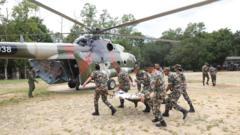
The Nepalese army had rescued more than 100 people by helicopter , an army spokesperson said. Army teams also evacuated people trapped inside facilities linked to the Trishuli hydropower project, he said. Dozens of injured people were transported to Kathmandu for medical care.
Rescuers found bodies in Nepal’s Chitwan district , hundreds of kilometres downstream from the hardest-hit areas.
The Nepal Red Cross Society said it had shifted focus from rescue to large-scale relief operations in the flood-hit districts.
China’s premier, Li Qiang, arrived in Gyirong on Thursday to direct rescue efforts , alongside 500 military and paramilitary personnel.
UN humanitarian chief Tom Fletcher said he ordered the release of $2m from the UN’s central emergency response fund to help with medical care, shelter and water.
Continuing now from the post on the latest breakout by country of at least 1,468 people missing from the Nepal-Tibet disaster, care of the AFP news agency.
Nine Singaporeans were unaccounted for, the Nepal tourism board said on Thursday.
Eight German citizens are missing, the board said.
Eight Russians are unaccounted for, while two had been rescued, the board said.
These numbers are from the Nepal tourism board’s updated figures, unless noted.
New Zealand : five (foreign ministry and Nepal tourism board)
Spain : four (Spanish foreign ministry. The Nepal tourism board put the figure at three)
Hungary : three (Hungarian foreign ministry. The Nepal tourism board put the figure at one.)
Portugal : three (Portuguese foreign ministry and Nepal tourism board). The foreign ministry also said one person had been located.
Italy : three missing (Italian foreign ministry), with two rescued (Nepal tourism board)
Sweden : one (Swedish foreign ministry and Nepal tourism board. The foreign ministry also said a second Swedish resident, a foreigner whose nationality was not identified, was among the missing.)
The figure on missing that China released on Thursday from its side of the border included 260 foreigners, but no breakdown on nationalities was provided.
Eight people whose nationalities had yet to be confirmed had been rescued, the Nepal tourism board said.
China warns of high flood risk from rising lake
Chinese authorities have warned that an artificial lake formed after a mudslide hit the Tibet-Nepal border faces a “high risk of breaching and sending floodwaters downstream” , according to state media.
“According to forecasts, inflows into the lake could reach about 3 million cubic meters over the next three days amid continued rainfall, increasing the risk of a breach that could send floodwaters downstream and potentially cause further damage in areas including Gyirong Port and elsewhere downstream”, state news agency Xinhua said late on Thursday, cited by AFP.
Almost 1,500 missing – the numbers by country
More than 1,400 people are still missing and 392 have been confirmed dead after the flash floods and landslides on the Nepal-Tibet border.
Here’s the latest tally of the missing, care of Agence France-Presse. As it points out, double-counting of dual nationals, matching bodies with people listed as missing and the chaos of a calamity can all contribute to fluctuations both upwards and downwards in the figures.
Nepal ’s disaster agency said 910 people were unaccounted for on Thursday, including at least 517 foreigners. It did not give a breakdown of the nationalities of the foreigners.
Across the border with Tibet, China said 558 people – including 260 foreigners – were missing. Together, the total missing on both sides of the border is 1,468.
Nepal’s tourism board on Thursday put the number of missing tourists and travellers – Nepali and foreign – at 667 in total. Its further breakdown of the nationalities is included below.
The new Nepal tourism board figures on Thursday said that 127 Nepali visitors were among the 667 it listed as missing. It was not immediately clear how many Nepali residents of the area were unaccounted for.
China’s foreign ministry said nearly 100 Chinese nationals were among the missing in Nepal. The Nepal tourism board said 24 Chinese were unaccounted for. That was in addition to the 558, including 260 foreigners, missing on its the Chinese side of the border.
Nepal’s latest tourism board figures showed 178 people from India were missing. Eleven others had been rescued.
Ninety US citizens were missing, the state department said, adding that three had been rescued and it was not aware of any US fatalities. The Nepal tourism board put the figure at 65 unaccounted for earlier Thursday.
Ukraine’s foreign ministry said on Thursday evening that the total number of Ukrainians listed as “out of contact” was 56. “According to the verified information available, there are currently no Ukrainians among the injured or deceased as a result of the disaster,” it added.
Prime minister Anwar Ibrahim said Thursday that more than 50 Malaysians in Nepal were unreachable. The Nepal tourism board put the number at 51.
The number of Australian nationals missing following the floods has risen to 39, foreign minister Penny Wong said on Friday.
Thirty-three people from the UK were missing, the Nepal tourism board figures showed.
The tourism board said 25 Canadians were among the missing on Thursday. But Canadian foreign minister Anita Anand said the government was “aware of 30 Canadians and permanent residents in Nepal and Tibet whose whereabouts and well-being have not yet been confirmed”.
South Korea’s foreign ministry said on Wednesday that nine hydropower workers were out of contact in the Rasuwa district following the floods. The Nepal tourism board said Thursday that four South Koreans had been rescued.
The number of Australians missing in the Nepal floods has increased from 35 to 39 , the Australian foreign minister has said, also pledging A$5m ($3.6m) in aid for affected communities.
Penny Wong said the Australian government was “rapidly mobilising consular and humanitarian support in response” to the flooding.
We understand at least 39 Australians are among those reported missing. Australian officials are working urgently to confirm their welfare and provide assistance to those affected.
Wong said on Friday the government would send an initial team of three humanitarian response specialists “within the next 48 hours’” to help Australian staff already on the ground.
The extraordinary scale of this disaster and the remoteness of the affected region mean immense challenges lie ahead for the response and recovery.
Further to the last post, the formation of a barrier lake was captured in aerial footage by a Chinese rescue team on Thursday , state broadcaster CGTN reported.
The footage showed masses of brown water accumulating in a basin with no visible outlet. The water had already submerged bushes and trees and appeared to push against a barrier of debris and stones.
Rainfall forecast over the coming week will exacerbate the threat, Chinese state media said, citing the Chinese water resources ministry.
“The volume of water is continuing to increase, and so is the risk,” Zhu Jinfeng , a researcher at the water resources ministry’s hydrology department, told state broadcaster CCTV.
Heeding the warning, some rescue workers in Nepal began moving towards higher ground on Thursday, Reuters reports.
Among them was Pawan Koirala , who began moving away from the river bed along with his team of 13 after the warning was issued. He said:
We are here for rescue and don’t want to be near the danger zone.
Fears rising lakes could burst and cause new floods
Nepal and China have both warned of fresh risks of flooding in the Himalayas as two lakes that have developed on either side of their border threaten to burst in a region still grappling with the disastrous flash flooding.
Both countries have blamed the flood on a glacier collapse that pushed rock, ice, mud and debris into river systems in the mountains.
Nepal’s disaster authority issued a notice on Thursday warning that a lake formed by debris blocking a river at the flood site was rising and at risk of bursting.
“Residents of the lower banks ... passengers, rescuers engaged in rescue operations, and all concerned are requested to exercise special caution and stay in safe places away from the river banks and risky areas,” the authority said, cited by Reuters.
China warned that 3m cubic metres of water – the equivalent of about 1,200 Olympic swimming pools – are expected to flow into an already dammed lake on its side of the border over the next three days, creating a high risk of a breach, with peak flow expected around Monday.
Red Cross launches $31m appeal for disaster response
The Red Cross has launched an emergency appeal for $31m to respond to the catastrophic flash floods that hit Nepal and Tibet.
The Switzerland-based International Federation of Red Cross and Red Crescent Societies (IFRC) launched the drive for 25m Swiss francs a day after releasing 1m francs to support immediate lifesaving efforts.
The appeal is to cover the emergency disaster response as well as medium- and longer-term recovery over the next two years.
“While we are getting a clearer picture of the scale of devastation, we know that entire villages were washed away and needs will grow in the coming hours and days,” IFRC secretary general Jagan Chapagain said in a statement.
Communities that have lost homes and livelihoods will need sustained support as they recover and rebuild.
Current estimates suggest around 93,000 people may have been affected, while assessments continue in hard-to-reach areas.
The remoteness of the affected areas, combined with damaged infrastructure, is making it harder both to assess the full scale of the disaster and to deliver assistance to people who need it most.
When Suman Shrestha opened his phone at work and saw vision of a thick, muddy wall of flood water smashing into towns in his country of birth, he almost did not believe what he was seeing, write Henry Belot and Kat Wong .
“It was awful – I called my family to see if this was really happening and to see if the news reports were right,” says Shrestha, who moved to Australia from Kathmandu in 2017.
It wasn’t long until the truth hit home. Like many of the 210,000 people who were born in Nepal but now call Australia home, Shrestha has spent the last 24 hours scrambling to find out if his loved ones are safe.
“I can see that lots of my friends are missing,” says Shrestha, who now lives in Gosford. “We can’t get in contact with them because the communications have been cut off in that area.”
Nearly 1,300 people are missing and at least 389 have been killed in Nepal and Tibet by the flood, which was caused by an avalanche of ice and rock on Wednesday. At least 39 Australians have been reported missing in the area, including a child as young as 11.
Related: ‘Lots of my friends are missing’: fears and prayers as Australia’s Nepali diaspora desperately seek answers after flood
Number of Australians missing in Nepal increases to 39
Foreign affairs minister Penny Wong has confirmed the number of Australians missing in the Nepal floods has increased overnight from 35 to 39.
In a statement on Friday morning, Wong said the government was “rapidly mobilising consular and humanitarian support in response to the catastrophic floods along the Nepal-China border, including through a $5 million assistance package for affected communities.”
“We understand at least 39 Australians are among those reported missing. Australian officials are working urgently to confirm their welfare and provide assistance to those affected.
She said the government would send an initial team of three humanitarian response specialists “within the next 48 hours’” to help Australian staff already on the ground.
“The extraordinary scale of this disaster and the remoteness of the affected region mean immense challenges lie ahead for the response and recovery.”
Related: Number of Australians missing in Nepal increases to 39, Penny Wong confirms
A nurse said his relatives were “swept away” by the devastating flash floods in Nepal , as he launched a fundraiser to support those affected by the disaster.
Rajendra Pudasaini, president of the Non-Resident Nepali Association UK, said Nepal was witnessing an “irreplaceable loss”, adding that the country was “paying the price for global warming”.
The nurse, who works at Princess Alexandra Hospital in Harlow, Essex, told the Press Association: “My wife’s auntie and uncle, and their granddaughter and her husband are missing, and my godson as well.
“They’re gone. The speed the water came, they couldn’t be saved, they were just swept away.
“The town and the villages were swept away, it’s a tragic thing.”
Officials said about 90 US citizens remained unaccounted for Thursday. Many of the missing were on a pilgrimage to Mount Kailash in Tibet, a sacred site for Hindus, Buddhists and others.
Among those on a guided tour was Venus Rajnikant Patel, a 45-year-old Indian-born US citizen who recently moved from St Louis to Cincinnati to help his family.
Patel’s friend Jolene Gosha said she and her friends knew Patel was in Nepal and were devastated when they realised he was staying at a hotel along the border where the floods swept through.
“We’re just hoping, hoping that by some chance he was able to climb his way out of it,” Gosha told the AP news agency.
“I don’t want to give myself false hope because I know the reality is that he’s probably not with us.”
Nepal’s National Disaster Risk Reduction and Management Authority said the number of out-of-contact foreign nationals had increased to 517.
The international community was scrambling to get aid into flood-stricken parts of Nepal and Tibet on Thursday as authorities warned that a lake formed at the site where the deadly torrents occurred was rising and at risk of bursting.
The catastrophic flash floods that hit Nepal and Tibet on Wednesday, thundering down valleys and obliterating entire villages, killed at least 359 people and left more than 1,300 missing.
Efforts to locate those unaccounted for – including hundreds of tourists from India, the US, Britain, Australia and Canada – have been complicated by the destruction of dozens of bridges and 25 miles (40km) of roads in the mountainous region, which is popular with trekkers and pilgrims.
Rescue teams reported finding bodies hundreds of miles downstream from the disaster zone in the Chitwan district of Nepal, near the Tibetan border. Dozens of injured people were transported to Kathmandu for advanced medical care and more than 100 people were rescued by Nepali army personnel in helicopters.
Videos from Wednesday’s disaster showed a massive wall of water crashing down on the border as people tried to flee. The power, volume and speed of the floods gave little time for escape.
Trucks were overturned and houses, roads and power plants were swept away in Nepal, while officials in Tibet said they feared “major casualties” after a mudslide hit a border crossing.
Related: Race to get aid into Nepal and Tibet amid warnings flood lake could burst
'Tsunami from the sky': floods leave trail of devastation in Nepal and Tibet - podcast
Hundreds of people are missing or have been killed after a catastrophic flash flood hit Nepal and Tibet on Wednesday. Entire villages have been destroyed, many of which are popular pilgrimage and trekking destinations for tourists.
In this edition of The Latest podcast, Lucy Hough talks to the Guardian’s global editor, Devika Bhat , about how the devastating event unfolded.
Climate crisis could be destabilising mountain areas like Nepal, experts warn
The devastating flash flood that ripped through the border communities of Nepal and Tibet has heightened fears that the climate crisis is destabilising the geology of mountain and polar regions, threatening millions of people .
Satellite imagery suggests a glacier collapse high in the Himalayas was the primary cause of the deadly torrent of mud, water and ice that tore along the Bhotekoshi River on Wednesday. It swept away buildings and roads and left at least 389 dead and 1,400 missing.
The ice-rock avalanche pushed boulders and other debris into the Lhende River, a tributary of the Bhotekoshi River. Water levels in rivers downstream rose by between 7 and 9 metres within 30 minutes, according to the International Centre for Integrated Mountain Development, an intergovernmental scientific institution.
Scientists are still examining the precise mechanics of the Himalayan disaster, but many observe that glaciers and permafrost around the world are being weakened by global heating, caused by the burning of gas, oil and coal .
The detachment of a chunk of the glacier wall came amid unusual heat that was likely to have melted the ice that bound the splintered bedrock together.
Two days before the collapse, the ground temperature hit its highest point in the last two years , according to Dr Hamish Pritchard, a glaciologist with the British Antarctic Survey, whose team had sensors 6 miles (10km) away from the site. He told the Science Media Centre:
These high temperatures would have weakened the snowpack, filled crevasses with water and thawed the bonds between ice and rock that hold these glaciers in place.
A series of intense heatwaves has hit the region since early this year and has affected countries around the world. Another factor here was the monsoon season, which saturated the soil and swelled rivers .
Disasters like this were foretold. In 2023 the UN’s top scientific advisory body warned that previously ice-bound landmasses – from permafrost tundra to mountain glaciers – would become increasingly unstable as temperatures rose.
Average global temperatures are nudging closer to 1.5C above pre-industrial levels . Even faster warming is occurring in alpine and polar regions because the loss of snow and ice is removing the thermal insulation of the land.
Dr Richard Waller, a senior lecturer in physical geography at Keele University, said:
The progressive loss of snow and glacier ice results in the surface being less reflective, so it absorbs more solar energy and heats up. In combination with atmospheric warming, this is leading to the melting of mountain permafrost.
Think of the high mountains like this as shattered bedrock glued together by ice-filled joints. As the permafrost and the ice-filled joints melt, then there’s the potential for these types of catastrophic failure.
The thaw is altering the shape, colour and solidity of the landscape, creating or expanding glacial meltwater lakes and, in the long term, threatening the origin of many rivers and the drinking supplies of populations downstream. In many parts of Asia hundreds of millions of people depend on the rivers, such as the Ganges and the Brahmaputra, that descend from the glaciers.
Scientists have high confidence that glacier retreat around the world is caused by human-driven global heating . This has caused glacier collapses from the Alps to the Andes. In the Langtang catchment area in Nepal, glacier loss rates have increased more than fourfold since 1964, a study has shown .
Jonathan Watts is the Guardian’s global environment editor. Read the full report here:
Related: Climate crisis could be destabilising mountain areas like Nepal, experts warn
Death toll rises to 389, policy say, with number of people rescued at 466
The latest update from Nepal police says that 389 people have been confirmed dead, and 466 injured and rescued.
According to the update, this is the number of recovered bodies by district:
Images coming over the news wires reveal the devastating aftermath of the flash flooding in Nepal.
Magnitude 5 earthquake hits Tibet, hundreds of miles north of Himalayan flood
A magnitude 5.0 earthquake struck China’s Tibet region late on Thursday, the German Research Centre for Geosciences said. Its epicenter was hundreds of miles north of the regions of Nepal and China that were hit by a devastating flash flood.
This earthquake comes after China’s networks center reported a magnitude 4.7 quake in Nagqu, Tibet, on Wednesday, state-run Xinhua news agency said.
How the deadly Nepal and Tibet flash flood unfolded – a visual guide
By Mark Saunokonoko, Nick Evershed, Mike Hohnen, Paul Scruton, Harvey Symons, Glenn Swann and Lucy Swan
At 8.37am on Wednesday, an enormous section of a glacier in the Himalayas sheared free and crashed on to the valley floor in Nepal’s Langtang national park, about 35 miles (60km) north of the capital, Kathmandu, near the mountainous Nepal-Tibet border.
Such was the force of the event, it was initially reported as an earthquake of magnitude 4.4. The US Geological Survey later determined the tremor was caused by glacial rock and ice collapsing, registering a magnitude of 5.2.
The collapse triggered a huge release of water, mud, rock and ice that thundered down valleys and swept down the Lhende, Bhotekoshi and Trishuli rivers.
Click the link below to see how this disaster unfolded:
Related: How the deadly Nepal and Tibet flash flood unfolded – a visual guide
The international community was scrambling to get aid into flood-stricken parts of Nepal and Tibet on Thursday as authorities warned that a lake formed at the site where the deadly torrents occurred was rising and at risk of bursting. The catastrophic flash floods, which hit Nepal and Tibet on Wednesday, thundering down valleys and obliterating entire villages, killed at least 359 people and left more than 1,300 missing.
Efforts to locate those unaccounted for – including hundreds of tourists from India, the US, Britain, Australia and Canada – have been complicated by the destruction of dozens of bridges and almost 25 miles (40km) of roads in the mountainous region, which is popular with trekkers and pilgrims.
Rescue teams reported finding bodies hundreds of miles downstream from the disaster zone in the Chitwan district of Nepal, near the Tibetan border. Dozens of injured people were transported to Kathmandu for advanced medical care and more than 100 people were rescued by Nepali army personnel in helicopters.
Rescue teams in Nepal are searching for at least 33 British nationals who are among those missing after flash floods ravaged its border with Tibet , killing at least 353 people. The tour company Kailash Journeys confirmed it had not been able to account for seven UK nationals – five women and two men aged between 18 and 55 – travelling with it.
A lake formed at the site where the flood in Nepal occurred is rising and is at risk of bursting, the country’s disaster authority said, as it appealed to residents and rescuers to stay away from the river banks. The blockage of a river on Wednesday led to the lake’s formation, Reuters reports the authority said.
Nearly 100 Chinese nationals were missing in Nepal in the area affected by a massive mudslide and flooding, China’s foreign ministry said on Thursday. Missing foreigners on the Chinese side include tourists, pilgrims and other personnel, and China is in close communication with Nepal on search and rescue while informing relevant embassies of the situation, foreign ministry spokesperson Lin Jian said at a regular press conference in Beijing
The UK has offered £5m to help the Nepalese government amid a “very distressing and devastating situation” following the country’s flash floods, the British prime minister has said. Andy Burnham told reporters an offer had also been made for emergency responders to head to the affected area.
The US says 90 of its citizens remain missing after the Nepal floods. The state department said it was not aware of any US deaths. Three Americans have been rescued.
At least 17,000 children have been affected by the devastating flash floods that tore through Nepal’s Rasuwa, Nuwakot and Dhading districts, Unicef has said. Among the confirmed dead are at least 14 children, with hundreds more still missing. The numbers are expected to rise as search operations continue.
Pope Leo XIV was “saddened” to hear about deaths and devastation caused by the floods in Nepal , and sent his condolences. On Thursday, the Vatican said the pope was “saddened to learn of the loss of life and devastation caused by the flash floods in Nepal.
The IFRC (International Federation of Red Cross and Red Crescent Societies), the world’s largest humanitarian network, posted a clip on X showing the destruction caused by the flooding. It said Red Cross teams are on the ground with food, safe drinking water, emergency shelter materials, first aid and other essential supplies, though roads are damaged and access is “extremely limited”.
Climate change is leading to conditions that can destabilise high-mountain rock and ice, strengthening prospects for disasters such as this week’s Himalayan flood along the border between Nepal and China’s Tibet, scientists say. While the exact cause of Wednesday’s disaster is still being analysed, scientists say it probably began with a massive ice-rock avalanche on the northern slopes of Nepal’s Langtang Lirung peak into the Lhende Khola river on the Tibetan side.
Scores of Hindu pilgrims from across the world are among those missing after deadly floods swept through the Nepal-Tibet border region, popular Indian spiritual leader Sadhguru said. The Hindu guru, whose real name is Jagdish Vasudev, posted an emotive video message from Tibet on his social media accounts, with several million followers.
Verified videos showed crushing masses of water and debris sweeping away dozens of people at a border crossing in Gyirong. Homes, roads and power projects were washed away in Nepal as the flows travelled downstream.
Race to get aid into Nepal and Tibet amid warnings another lake could burst
The international community was scrambling to get aid into flood-stricken parts of Nepal and Tibet on Thursday as authorities warned that a lake formed at the site where the deadly torrents occurred was rising and at risk of bursting.
The catastrophic flash floods, which hit Nepal and Tibet on Wednesday, thundering down valleys and obliterating entire villages, killed at least 359 people and left more than 1,300 missing.
Efforts to locate those unaccounted for – including hundreds of tourists from India, the US, Britain, Australia and Canada – have been complicated by the destruction of dozens of bridges and almost 25 miles (40km) of roads in the mountainous region, which is popular with trekkers and pilgrims.
Rescue teams reported finding bodies hundreds of miles downstream from the disaster zone in the Chitwan district of Nepal, near the Tibetan border. Dozens of injured people were transported to Kathmandu for advanced medical care and more than 100 people were rescued by Nepali army personnel in helicopters.
Videos from Wednesday’s disaster showed a massive wall of water crashing down on the border as people tried to flee, even though the power, volume and speed of the floods gave little time for escape.
Trucks were overturned and houses, roads and power plants swept away in Nepal, while officials in Tibet said they feared “major casualties” after a mudslide hit a border crossing.
Related: Race to get aid into Nepal and Tibet amid warnings another lake could burst
90 Americans missing in Nepal floods, US says
The US says 90 of its citizens remain missing after the Nepal floods.
The state department said it was not aware of any US deaths. Three Americans have been rescued.
At least 17,000 children have been affected by the devastating flash floods that tore through Nepal’s Rasuwa, Nuwakot and Dhading districts, Unicef has said.
Among the confirmed dead are at least 14 children, with hundreds more still missing. The numbers are expected to rise as search operations continue.
“Children across Rasuwa and Dhading saw their lives being literally washed away in front of their eyes in a very short span of time, with homes, classrooms, and medical facilities damaged. Too many lost their lives and loved ones,” said Alice Akunga, Unicef pepresentative to Nepal.
“With the death toll still rising, we know this tragedy is far from over. Children who have survived the floods now face heightened risks of disease, malnutrition, violence and exploitation. Unicef is on the ground and scaling up support, but we urgently need more resources to reach every child in need.”
The UK has offered £5m to help the Nepalese government amid a “very distressing and devastating situation” following the country’s flash floods, the British prime minister has said.
More than 30 British nationals are among hundreds of people missing and feared dead as rescue efforts continued on Thursday.
Andy Burnham told reporters an offer had also been made for emergency responders to head to the affected area.
Nepal police confirm death toll stands at 359 people
Nepal police have now confirmed the number of dead stands at 359 people.
Of these, 359 bodies have been found, including 17 in Rasuwa, 28 in Nuwakot, 33 in Dhading, 132 in Chitwan, 30 in Gorkha, 22 in Tanahun, 82 in Nawalparasi East, and 15 in Nawalparasi West.
The police are also working to keep various households in various districts at risk of flooding in safe places, carry out necessary rescue and search operations in coordination and cooperation with various agencies and locals, and remove roadblocks at various locations.
A lake formed at the site where the flood in Nepal occurred is rising and is at risk of bursting, the country’s disaster authority said, as it appealed to residents and rescuers to stay away from the riverbanks.
The blockage of a river on Wednesday led to the lake’s formation, Reuters reports the authority said.
At least 353 people were killed, police said, and more than 1,300 are missing, including scores of foreigners and pilgrims, according to AP.
Hundreds others have been displaced across the Himalayan region.
Traffic is at a standstill along some major routes in Nepal, such as the Kalanki-Thankot-Nagdhunga route in the capital, Kathmandu, and some roads remain closed or difficult to access due to the floods.
King Charles III has responded to the disaster in Nepal and Tibet. In a written message, the king said:
My wife and I are heartbroken to hear of the devastating flooding that has struck the Nepal-China border.
Many in the United Kingdom have strong, deep and personal ties to this part of the world.
We send our most profound sympathy to all those who have so tragically lost their loved ones and we feel deeply for the many families awaiting anxiously the news of friends and relations.
Our hearts go out also to the families of all the police and Armed Forces personnel who lost their lives while carrying out their courageous duty in the service of others and we give our deepest thanks to those who have responded so selflessly in undertaking rescue efforts.
Our special thoughts and prayers remain with all those affected and, as always, the United Kingdom stands ready to help support those in need.
Kabita Dhungana, deputy mayor of Nuwakot in Nepal, the district affected by the floods, said “please help us”, as she spoke to BBC Radio 4’s The World at One about the flash floods her region is experiencing.
Family members, children, parents are missing, and this is a very critical bad situation…
Everything, basic needs are destroyed, so please help us. We are really in need of help.
The EU is ready to “mobilise further European assistance”, the European Commission president, Ursula von der Leyen, said on X.
Srijana Gurung, Plan International Nepal acting country director, said the climate crisis means floods and landslides are “far more frequent and intense”, as she highlighted the need of urgent medical care and risk of waterborne diseases in the aftermath of the floods in Nepal.
Across Nepal, communities are facing climate shock after shock with barely any time to recover. Floods and landslides have always happened in Nepal but the climate crisis is making them far more frequent and intense.
The priority now must be reaching those affected, supporting families searching for loved ones, and ensuring vulnerable communities have the assistance they need.
Children and their families who have lost their homes and livelihoods will be in urgent need of medical attention, shelter, water, food and hygiene kits. There is also a risk of waterborne disease as access to clean water and sanitation is likely to have been damaged.
Particular attention must be given to those most at risk, including girls, women, older people and people with disabilities, while ensuring their rights, safety, dignity and voices remain at the centre of the response.
This dramatic image shows the moment that flood waters hit a hydroelectric dam that was under construction on the Trishuli river in Nepal .
New risk as lake in flood area threatens to burst as 353 confirmed dead
A lake formed at the site where the flood in Nepal occurred is rising and is at risk of bursting, the country’s disaster authority said, as it appealed to residents and rescuers to stay away from the river banks.
The blockage of a river on Wednesday led to the lake’s formation, Reuters reports the authority said.
Meanwhile Abi Narayan Kafle, the central spokesperson for the Nepal Police, has told AP 353 people were now confirmed dead in the floods as of Thursday.
Confirmed death toll in Nepal flood rises to 332
Reuters has a quick snap that local media has reported that 332 bodies have now been recovered by authorities after the deadly flood in Nepal.
More than 900 people remain unaccounted for. In addition China’s state broadcaster has issued a figure of three confirmed deaths and more than 500 people missing in Tibet.
Rescue teams have found bodies hundreds of miles downstream from the disaster zone in the Chitwan district of Nepal, near the Indian border.
A New South Wales couple on a spiritual pilgrimage are among the first of 35 Australians identified as missing after flash flooding ravaged the Nepal-Tibet border. The Australian government said officials were “working around the clock” to check welfare of tourists missing in Nepal.
Related: How the deadly Nepal and Tibet flash flood unfolded – a visual guide
Pope Leo XIV was “saddened” to hear about deaths and devastation caused by the floods in Nepal, and sent his condolences.
On Thursday, the Vatican said the Pope was “saddened to learn of the loss of life and devastation caused by the flash floods in Nepal.
A note written by the Vatican’s secretary of state, Cardinal Pietro Parolin, read:
His holiness sends heartfelt sympathies to the bereaved, together with the assurance of his spiritual closeness to those affected by this tragedy.
Vivian Balakrishnan, Minister for Foreign Affairs of Singapore, said Singapore stands in solidarity with Nepal and China and pledged emergency assistance.
Singapore stands in solidarity with Nepal and China during this difficult time. We are putting together a humanitarian assistance package to support relief efforts in Nepal. A Consular Response Team will be deployed to assist affected Singaporeans on the ground.
Here are some of the latest images from the news wires.
The IFRC (International Federation of Red Cross and Red Crescent Societies), the world’s largest humanitarian network, posted a clip on X showing the destruction caused by the flooding.
It said Red Cross teams are on the ground with food, safe drinking water, emergency shelter materials, first aid and other essential supplies, though roads are damaged and access is “extremely limited”.
Severe flash floods have devastated northern Nepal, destroying homes, washing away bridges and cutting off communities.
Nepal Red Cross teams are responding with food, safe drinking water, emergency shelter materials, first aid and other essential supplies, despite damaged roads and extremely limited access.
The IFRC has released CHF 997,000 from its Disaster Response Emergency Fund, including an immediate CHF 100,000 advance to support urgent response efforts.
As the full scale of the disaster becomes clearer, we stand ready to provide further support and international assistance if needed.
CHF 997,000 is equivalent to about £911,000.
Britain has pledged £5 m and offered to send emergency responders to Nepal following the “devastating” flash floods there, the UK prime minister, Andy Burnham, has said.
Speaking to journalists during a visit to South Wales, the prime minister said:
It’s a devastating picture that is emerging from what has happened in Nepal.
Scenes that we’ve never seen the like before, I don’t think, certainly the scale of the devastation.
So there is immediate action being taken. We are deploying consular support staff to the region so that British nationals will be able to access support 24/7. An offer has been made of emergency responders to head to the region but that’s obviously a matter for the Nepalese government.
But also we’ve offered £5m to help with that response effort.
Obviously, there are a number of British nationals who currently are thought to be missing and we’ll be providing all the support we can to their families in what is a very distressing and devastating situation.
Nepal police say 270 bodies found after Himalayan flood
A total of 270 bodies have been found by authorities in Nepal after a torrential flood swept through the Himalayan border areas of the country and China’s Tibet, Reuters reports, citing what Nepal’s police said in a post on X.
Climate change is leading to conditions that can destabilise high-mountain rock and ice, strengthening prospects for disasters such as this week’s Himalayan flood along the border between Nepal and China’s Tibet, scientists say.
While the exact cause of Wednesday’s disaster is still being analysed, scientists say it probably began with a massive ice-rock avalanche on the northern slopes of Nepal’s Langtang Lirung peak into the Lhende Khola river on the Tibetan side.
Experts caution against describing climate change as the sole, immediate trigger for Wednesday’s collapse, though they say that rising temperatures and melting glaciers probably played a role in the disaster.
Simon Cox, chief scientist at the Mountains to Sea programme at Earth Sciences New Zealand, said:
Climate change is generating conditions that can destabilise high-mountain rock and ice.
That in turn makes collapses and cascading hazards of the kind seen this week more frequent, he added.
At least 168 people are dead and people from more than 30 countries are missing after the flash floods in Nepal and China.
Authorities in Nepal and China countries have reported more than 160 deaths and over 1,300 people missing. The number of missing may vary across agencies due to differences in how they collected data, when it was reported and how it was verified, according to AP news agency.
Nearly 100 Chinese nationals were missing in Nepal in the area affected by a massive mudslide and flooding, China’s foreign ministry said on Thursday.
Missing foreigners on the Chinese side include tourists, pilgrims and other personnel, and China is in close communication with Nepal on search and rescue while informing relevant embassies of the situation, foreign ministry spokesperson Lin Jian said at a regular press conference in Beijing
As the search and rescue continues, here are some of the latest images.
Scores of Hindu pilgrims from across the world are among those missing after deadly floods swept through the Nepal-Tibet border region, popular Indian spiritual leader Sadhguru said.
The Hindu guru, whose real name is Jagdish Vasudev, posted an emotional video message from Tibet on his social media accounts, with several million followers.
In the statement, he said 80 pilgrims were at the Nepal-China border immigration office when the flood hit on Wednesday, he said in a post alongside a terrifying clip of a surveillance video from the Chinese side of the frontier, when a wall of mud and debris crashed over the border building.
Of the pilgrims, 22 are from the United States , 12 from Canada , 11 from Australia , nine from the United Kingdom , 4 from Germany , 3 from France , 3 from Nepal , 2 from The Netherlands , 2 from New Zealand , Spain and Singapore , 1 from Finland , Hungary, Israel, Lithuania, Philippines, Portugal, Russia and South Africa . He added that 34 of the pilgrims were men, and 46 women. These claims have not yet been independent verified.
Literally, the entire group was there in the building, this is a terrible and extraordinary event.
All phones are off, telecommunications are down, roads are blocked, we are unable to go there.
The pilgrims were part of several Hindu groups organised by Isha Foundation of Sadhguru, who had been visiting the snow-capped Mount Kailash in Tibet, sacred also to Tibetan Buddhists.
The pilgrimage to Kailash and Lake Mansarovar is organised annually by India’s foreign ministry with Chinese authorities. It restarted in 2025 for Indians for the first time since the 2020 clash.
Here’s a snapshot of the latest developments:
More than 1,000 people including almost 800 foreigners are missing across Nepal and Tibet , authorities say, after a wall of mud and rock collapsed into a Himalayan river, sending catastrophic flash floods through towns and valleys.
Rescuers in Nepal used helicopters to search for survivors and drop emergency supplies to thousands cut off after Wednesday morning’s disaster.
Police said they expected the death toll to rise beyond 165 as more bodies were recovered.
Almost 500 foreigners were among 826 people missing in Nepal , police and tourism officials said. Among the missing tourists from more than two dozen countries, 177 were from India, 63 from the US, 34 from Australia, 33 from the UK and 25 from Canada.
The count of missing in Tibet’s Gyirong county was 558 , Chinese state broadcaster CCTV said on Thursday, including 260 foreign nationals. China said the death toll stayed at three.
Verified videos showed crushing masses of water and debris sweeping away dozens of people at a border crossing in Gyirong. Homes, roads and power projects were washed away in Nepal as the flows travelled downstream.
More than 5,000 Nepalese army and police rescue personnel joined the rescue effort that retrieved 125 people on Thursday, including 20 foreigners, an army spokesperson said.
Nepalese prime minister Balendra Shah left by road for Bidur in one of the worst affected districts of Nuwakot to assess the flood situation, his office said on social media.
The US Geological Survey said a glacial collapse caused seismic activity and catastrophic impacts in Nepal and Tibet. Seismic activity initially reported as an earthquake “was instead a glacial collapse and debris flow” that “caused subsequent catastrophic impacts downstream”, the agency said on Thursday..
Chinese authorities have identified risks from a still-dammed lake located in Gyirong , upstream from the mudslide and flood-stricken Tibet-Nepal border crossing, that could significantly complicate rescue efforts in the mountainous site, CCTV reported on Thursday.
Many of the victims were making a pilgrimage to Kailash Mansarovar, a high-altitude site in Tibet revered by Hindus and Buddhists among others.
The US State Department said it was providing assistance of $500,000 and sending a disaster response adviser.
Search continues for dozens of missing British
Rescuers are searching for dozens of British nationals who are among those missing and feared dead in Nepal after the devastating flash flooding.
The number of missing had risen from 403 to 826, the National Disaster Risk Reduction and Management Authority in Nepal said on Thursday, and 165 bodies had been recovered. On Wednesday the Nepal tourism board said 33 UK citizens were among the then 341 foreign nationals unaccounted for.
Kalpana Malla , from Nepal’s Nuwakot district, told BBC News: “My family members were swept away by the flood in front of my eyes.”
She said her father, mother, sister and her sister’s children were all swept away by the floods. She added:
They could not escape the flood, there was no chance at all.
This flood took everything, but my son and I climbed the rooftop of a house and survived, but couldn’t explain how.
Rajan Shrestha , the mayor of Bidur municipality, told the Times that he had “never seen such a massive flood in my life” and estimated about 400 people may have been swept away. He added:
And it came so fast. We could not evacuate all the people from the main town.”
Tour operator Alpine Eco Trek said a 13-year-old girl was among the missing British nationals, as well as two Irish citizens, PA Media reported.
Among the missing British nationals were three men aged 65, 64, and 52, and seven women aged 44, 47, 51, 60, 63, 63, and 65, according to travel logs obtained by the news agency.
Prime minister Andy Burnham said the government would do “everything we can” to support British nationals in Nepal after the floods.
The US Geological Survey is saying a huge glacial collapse caused the catastrophic flash floods in the Himalayan border region of Nepal and Tibet.
Here Mark Saunokonoko , Nick Evershed and Mike Hohnen trace what occurred using video footage, maps and images including satellite views.
Related: How the deadly Nepal and Tibet flash flood unfolded – a visual guide
Australia’s foreign minister has said at least 34 Australians in Nepal are missing but information there is “very limited”.
We understand these Australians are part of separate pilgrimage and tour groups.
At this stage, access and information are very limited given the scale of disaster … we are urgently seeking to confirm the welfare and whereabouts of Australians.
Himalayan Glacier Trekking, a tourism agency operating in the area, confirmed 15 of the missing Australians were on a religious tour to Mount Kailash it was organising. The group also included people from India, the US, Canada and Singapore.
All 15 were Indian-Australians, with the youngest an 11-year-old boy, the tour operator said.
More than 1,000 missing, the majority of them tourists
More than 1,000 people have now been declared missing after a catastrophic flash flood in Nepal and Tibet, the majority of which are tourists.
Nepal’s disaster agency has said 823 people remain out of contact on Thursday, more than 24 hours after the disaster hit. The 823 included at least 579 tourists, both Nepali and foreigners, it said in an update.
At least 165 people are confirmed killed, in both Nepal and in China, where a further 558 people are reported missing.
It was not immediately certain the numbers of missing were entirely separate or if any had been counted twice in the two countries’ tallies.
The US government has promised to provide $500,000 in emergency assistance to Nepal, the state department said.
The United States extends its deepest condolences to the families and loved ones of those who lost their lives in the devastating flash floods in the Rasuwa district of Nepal.
In a message on X, secretary of state Marco Rubio added his support, saying: “We express our solidarity and are united in prayer for the Nepali people following the devastating floods.”
Eyewitness accounts have been emerging from the Tibetan side of the border , with a woman saying she was travelling from Gyirong town towards Nepal on Wednesday morning when her group encountered the flood about 4km from Gyirong port.
“Trees and electricity poles had already been knocked down, and the flood water was bearing down on us. We didn’t dare turn around, so we could only reverse,” the woman, surnamed Fang, told Xiaoxiang Morning News .
She eventually returned safely to Gyirong town but said that about 5pm was still unable to reach a friend who had been at the port.
Separately, the husband of a worker on a Chinese road-rehabilitation project in Nepal said his wife had been staying at a project camp beside the river, about 3km from the Gyirong customs building.
“We were still in contact last night. It wasn’t until 11am that I learned there had been a mudslide, and since then I haven’t been able to reach my wife or anyone at the project site,” he told China Newsweek .
The project had three riverside camps employing about 60 Chinese workers, all of which had lost contact, he said.
On the Nepal side of the border, a tourist said they suddenly heard “a roaring sound, as if the mountainside was being torn apart” before a torrent of mud surged through the valley.
They said that at its closest the mud was only about a metre below where they were standing, telling Red Star News :
I was really scared. My whole body was trembling.
Continued from the last post on the number of people missing in Nepal:
Prime minister Sanae Takaichi said she was “concerned” by media reports that five Japanese nationals were missing after the flooding.
Four South Africans travelling with the same Alpine Eco Trek agency as the British citizens were missing, according to the Nepal tourism board.
Three US citizens, also with Fishtail Tours + Travels, were unaccounted for, the board said.
Portugal’s foreign ministry said a woman and a man had gone missing in the floods.
A Dutch citizen travelling with the same company as the missing Australian was also unaccounted for, the board said.
The Italian foreign ministry said two of its nationals and their guide were stranded upstream from a landslide but were receiving help. The ministry was aware of 90 Italian citizens currently in Nepal and Tibet, but did not know if any might have been affected.
Several of the tour groups also announced missing foreigners whose nationalities had not been confirmed. They included 77 with Trekkers Society, 26 with Kailash Journey and eight with Richa Tours + Travels.
The Nepali tourism board also said that, in addition to the unaccounted-for foreigners, a total of 93 Nepalis were missing.
Foreigners missing in Nepal – latest numbers
Hundreds of foreign nationals are missing in Nepal after the catastrophic flash flooding killed at least 160 people.
Hikers and climbers from worldwide travel to the Himalayan nation to test themselves on some of the world’s highest peaks, Mount Everest among them.
Here’s the latest on how many people are still out of contact in Nepal, care of Agence France-Presse.
Chinese state media has said separately that in Tibet’s Gyirong county the number of missing had risen to 558, including 260 foreign nationals.
According to the Nepal tourism board, 142 nationals from neighbouring India were missing. They were in the country with three travel agencies: Samrat Tours + Travels, Leaf Holiday and Himalayan Glacier.
Ukraine’s foreign ministry said Nepal’s tourist police had informed them that they believed 53 Ukrainian nationals were missing. They included a group of 46 Ukrainian tourists with whom the authorities in Nepal had lost contact, the ministry added.
Seventeen Malaysians travelling with Fishtail Tours + Travels were missing in the floods, the Nepal tourism board said. Malaysia’s foreign ministry said its embassy in Kathmandu had received reports from travel agencies suggesting they had lost contact with 11 Malaysian nationals believed to be in the Rasuwa district.
Thirty-four Australians are missing following the floods, prime minister Anthony Albanese said.
Twelve UK citizens with the Alpine Eco Trek agency were unaccounted for, the tourism board said.
The South Korean foreign ministry said nine hydropower workers were out of contact in the Rasuwa district.
Hundreds now missing in disaster after officials update tolls
The number of people missing in Tibet’s Gyirong county has increased to 558 , according to Chinese state media, while Nepal says 468 tourists and travellers remain out of contact – putting the apparent overall number of missing at more than 1,000.
Chinese state broadcaster CCTV said on Thursday that of the 558 missing, 260 were foreign nationals, CCTV said. The death toll remained at three, it said.
Separately, Nepal said 468 tourists and travellers – including 393 foreigners – remained out of contact on Thursday, 24 hours after the deadly flood tore through the border region with Tibet.
It was not immediately certain the numbers of missing were entirely separate or if any had been counted twice in the two countries’ tallies.
A Nepal tourism department spokesperson, Suraj Ghimire , told Agence France-Presse: “About 468 tourists and travellers are out of contact, among them 75 are Nepalis.”
Flood devastation and rescue operations – in pictures
Here are some of the latest images coming in from the Nepal-Tibet border area as the disaster continues to unfold.
A Nepali tour operator says he fears that 15 Australians trekking with his company in a valley ravaged by the flash flooding have died .
Sagar Pandey , founder and chief executive of Himalayan Glacier Trekking, said he had lost all contact with his tour group of 47 people, which included 15 Australians.
The missing Australians range in age from 11 to 64 and the group is believed to include two families of four from the state of New South Wales.
Pandey has since flown by helicopter over Nepal’s Rasuwa area, where the tour was staying, and said he had little hope they survived.
To be honest … you would think there was no human civilisation there at all.
The flash flood swept away everything, everything, you couldn’t see any human creations.
Still, I have a hope, but like 1%; the rest I don’t have a hope, they are missing and missing and missing.
Pandey, who is also president of the Trekking Agencies’ Association of Nepal, said he had been coordinating with other local tour groups, which had also lost contact with their guides in the area.
Nepal’s tourism board said earlier that 34 people from Australia were among those missing.
More here on the cause of the disaster after the US Geological Survey (USGS) said there had been a glacial collapse that caused seismic activity and catastrophic impacts in Nepal and Tibet.
The agency said seismic activity initially reported as an earthquake “was instead a glacial collapse and debris flow” that “caused subsequent catastrophic impacts downstream”.
The cause of the disaster was not immediately clear in the hours after it occurred early on Wednesday, but Nepalese foreign minister Shishir Khanal had said an earthquake likely triggered a landslide, in turn blocking a river and sending water gushing downstream.
Other theories advanced included a glacial lake flood – when a fragile debris wall holding back glacier melt collapses – or an ice avalanche, as AFP reports.
The USGS said on Thursday that “a magnitude 5.2 seismic event occurred near the border between Nepal and China” on Wednesday at 8.37am local time.
This event was initially reported as a magnitude 4.4 earthquake. Additional analysis of nearby seismic stations, long period seismic waves, and satellite imagery led to the determination that the seismic event was instead a glacial collapse and debris flow, and that no earthquake had occurred.
As accounts from witnesses of the disaster emerge, one survivor has described being rescued while his wife is still missing , and another described being saved by clinging to a mango tree.
“It was a huge gush of mud coming straight towards us,” said Keshav Prasad Baral , 68, who was being treated at a small hospital. “As it got closer, it kept rising higher and higher.
When I saw it enter our home, I tried to grab my wife’s hand and take her to the terrace. But she was swept away by the mud.
Four or five hours later, a helicopter came to rescue me. My wife is still somewhere beneath the mud. She’s gone
Another survivor, also quoted by Reuters, described being saved by clinging to a mango tree as he watched the house where he had been working disappear.
The flash flood’s force washed away whole villages and markets as well as motor vehicles, roads and power projects.
Glacial collapse caused 'catastrophic impacts', says US agency
A glacial collapse caused seismic activity and “catastrophic” downstream impacts in Nepal and Tibet , the US Geological Survey is saying.
Seismic activity initially reported as an earthquake “was instead a glacial collapse and debris flow” that “caused subsequent catastrophic impacts downstream”, the agency said on Thursday, quoted by Agence France-Presse.
At least 160 killed in Nepal flash flood as search for hundreds missing continues
Authorities in Nepal and Tibet have said they fear the death toll from catastrophic flooding could be much higher than 160 people already killed, as search and rescue efforts to locate the hundreds missing continue.
A huge wall of mud and rock collapsed into a river on the Himalayan border of Nepal and Tibet on Wednesday, triggering the flash flood that washed away houses, roads and border crossings.
Verified videos showed dozens of people swept away at the border, with authorities on both sides fearing far higher casualties and massive destruction.
Officials in Tibet said they feared “major casualties” after a mudslide hit a border land crossing in the county of Gyirong.
As darkness fell, authorities continued the grim task of recovering and trying to identify bodies.
Nepal police said 157 bodies had been recovered so far. Three people were reported killed on the Tibet side of the border.
Initial reports from Nepali officials suggested an earthquake in the area could have caused the lower part of a glacier to collapse and trigger the floods. The USGS later said the tremor recorded at the time was caused by the glacial rock and ice collapsing to the valley floor.
Rescue teams are rushing on Thursday to find hundreds of people missing after the flood and landslides killed at least 160 people . Many of the missing were foreign tourists, officials said.
Nepali police said they had recovered 157 bodies after “devastating floods” , with officers working to move families in flood-risk areas to safety. Chinese state media reported “major casualties” from a mudslide at a Tibet border hub, reporting three dead and another 265 missing.
Tibet government officials mobilised nearly 800 emergency workers and 150 vehicles as well as sniffer dogs and speed boats to help the rescue efforts, China’s official Xinhua news agency said.
At least 403 tourists – 341 of them foreigners – were unaccounted for several hours after the disaster struck on Wednesday morning, according to Nepal’s tourism ministry. The missing foreigners included 142 Indians, 33 from the UK, 47 from the US, 34 from Australia and 24 from Canada as well as others from South Korea, the Netherlands, Malaysia, Portugal and South Africa, the tourism board said. Nine South Koreans were missing, Seoul’s foreign ministry said.
At least 28 Nepal police officials were missing , a police spokesperson said.
Entire villages and markets were “wiped out” , the International Federation of Red Cross and Red Crescent Societies said. It was dispatching emergency supplies including blankets, first aid kits, stretchers and body bags.
United Nations chief António Guterres said UN teams and partners were mobilising supplies and personnel in Nepal to support affected communities.
Surveillance video from the Chinese side of the border showed a raging wall of mud and debris crashing over a building several storeys high , engulfing it as dozens of people flee for their lives below. The surge swept away buses and cars.
Experts warned that a lingering blockage upstream on the Nepal-China border river could produce a second flood .
The cause of the flooding was not immediately clear . Nepalese foreign minister Shishir Khanal said an earthquake likely triggered a landslide, which in turn blocked a river, sending water gushing downstream. Nepal’s disaster authority said satellite data indicated a “snow-rock landslide” on the Nepal-China border may have caused the flood. Scientists say climate change is increasing the frequency and intensity of extreme weather events in the region.
Chinese leader Xi Jinping said “the most urgent task is doing everything possible to search for and rescue the missing people”, according to Chinese state broadcaster CCTV.
The US Geological Survey first reported a magnitude-4.4 earthquake early on Wednesday, about 66km (41 miles) north of Kathmandu, near the border. It later updated to call the shaking a 5.2-magnitude landslide.
You can also see our fresh rundown of what we know on day three and our latest full report , as well as a visual guide to how the flooding unfolded. Thanks for following along.
This report is published with credit to theguardian.com. Full available text from the wire is above. Read on theguardian.com →
Source: theguardian.com · Adam Fulton, Nadeem Badshah, Lucy Campbell, Shannon Ho, Tom Ambrose, Mabel Banfield-Nwachi and Martin Belam. Published 28 Aug 2026, 02:29 am.